Introduction
Stress is a universal phenomenon
affecting the physical, mental, and psychosocial wellbeing of
humans [1,2]. Being multifactorial, its burden increases when the
environmental stressors increase. Among these stressors on a nation level are
poverty, politically-driven economic instability, lack of direction, absence or
unenforced human rights laws, double standards, corruption, and lack of a
system in place, to name a few [3-11].
The Lebanese people have
sustained, and to some extent got engaged in a 15 years of civil war (1975-1990).
Although the war stopped, yet the economy and political hardships remain. The
stress disorders associated with the war and these hardships have been noted in
the attitude and behavior of the residents of the country, whereby many have
been exhibiting signs and symptoms of anxiety
and mood disorders [12]. Consequently, there has been a significant increase in
violence, harassment, abuse, road rage and related deaths and disabilities,
development of an indifferent attitude, divorce rate resulting in fragmented
families and single parents, financial inability to get married and start a
family, and social isolation, to name a few [12-17]. Although psychological
counseling is available, it remains out of reach for most of the Lebanese
people due to the high cost, being uninsured, or the insurance does not cover
the fees [12]. This leaves 9 out of 10 of individuals
requiring counseling/treatment without such a service or paying for it
out-of-pocket [12].
The country also suffers from a
significant shortage in forensic and mental health professionals [12].
Forensic inpatient facilities do not have beds for individuals with
stress-related disorders, and the absence of proper forensic units makes the
data on users and length of stay not available [12]. As such, establishing Forensic Nursing education,
and integrating Forensic Nursing into the practice of the profession could be
two important strategies that the government could use to alleviate the
shortage, especially in relation to early identification of signs and symptoms
of violence, abuse, harassment, and other physical and psychosocial injuries
inflicted on victims (children, adults, elderlies, and women).
Forensic
Nursing is defined as the practice of nursing
universally, whereby the legal systems and health intersect. Death
investigation, intimate partner violence, legal/criminal justice, and
administrative, correctional and psychiatric-mental health all represent
various specialties in Forensic Nursing. We aim in this study at surveying the
current status of Forensic Nursing in Lebanon in relation to education and
practice.
Materials and
Methods
We conducted two separate
comprehensive PubMed and Medline searches using MeSH terms “Forensic Nursing
education” AND “Lebanon”, and “Forensic Nursing practice”
AND “Lebanon”. We selected “All Fields” in both searches to ensure that if such
MeSH terms were included in the title, abstract, key words, or any other
components of the journal articles searched, then such articles will
automatically appear in our search. We did not use any of the filters available
in the PubMed and Medline search engines, such as article types, text
availability, publication dates, ages, search fields, languages, sex, subjects,
and journal categories, in order to avoid accidental exclusion of any article
that matches the MeSH terms we used.
In parallel, we reviewed the
catalogues and the related description of courses of the nursing programs
currently offered by the various universities, colleges, technical
institutions, and hospitals in Lebanon in relation to Forensic Nursing
education. Access to such catalogues and description of courses was obtained
through screening the related degree programs posted on the websites of these
universities, colleges, technical institutions, and hospitals. These websites
were located through Erasmus Plus Lebanon, and through visiting 132 individual
website links obtained through Google search for “nursing degree in Lebanon”
[18] (Figure 1).
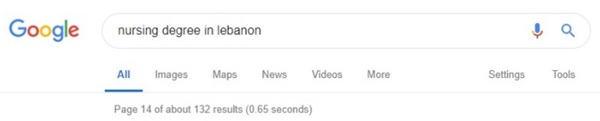
Figure
1: 132 individual website links which we visited
through Google search for “nursing degree in Lebanon”.
Finally, we reviewed the Lebanese
law for the existence of legislations in relation to the practice of Forensic
Nursing in Lebanon, and the current regulations governing the practice of
forensics in the country [19-21].
Results
Our literature search revealed a
total lack of publications about Forensic Nursing education, and Forensic
Nursing practice in Lebanon (Figures 2
and 3).
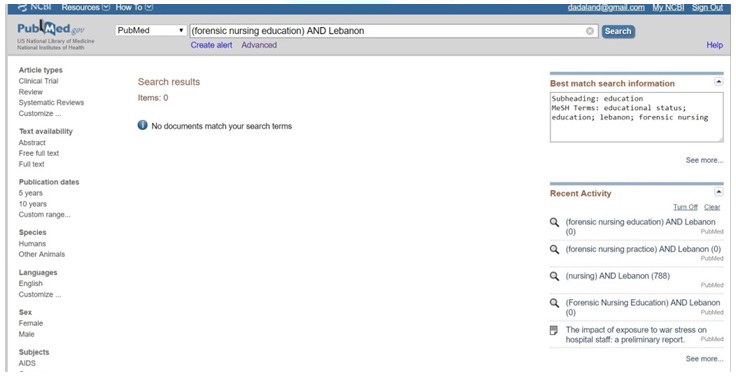
Figure 2: Results for the PubMed and Medline searches for
“Forensic Nursing education” AND “Lebanon”.
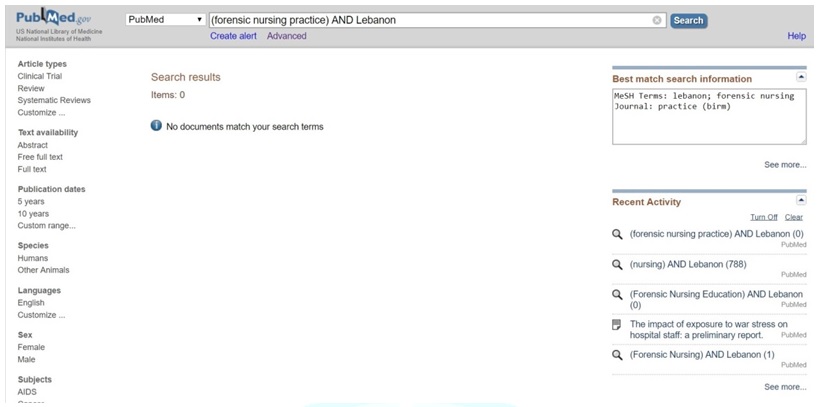
Figure
3: Results for the PubMed and Medline searches for
“Forensic Nursing practice” AND “Lebanon”.
There are currently 50 certified
higher education institutions in Lebanon [18]. The total number of these
institutions currently offering a bachelor degree in nursing is 18. The total
number of credits required to graduate nurses with a bachelor degree from these
institutions ranges from 99 to 188 credits. The average duration of the degree
is 3 years, excluding the freshman year. The language taught is either English
or French, with very few institutions exceptionally offering the degree in both
English and French. Some of the institutions offer a bridging nursing program
allowing the students with a Baccalaureate Technique (BT) or Technique
Superieure (TS) degrees in nursing to enroll in the bachelor degree (Table 1).
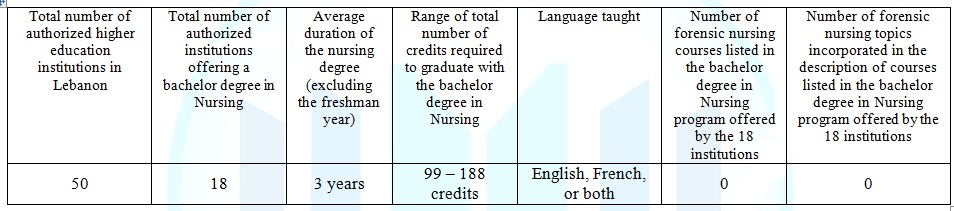
Table
1: Institutions offering a bachelor degree in Nursing
in Lebanon.
Our analysis of the bachelor in nursing degree
programs offered by the 18 institutions revealed a total absence of a
Forensic Nursing course. We then reviewed the course description of the
individual courses pertaining to these programs aiming at assessing whether Forensic
Nursing has even been covered as a topic in these courses. Our findings turned
out to be negative.
Finally, our thorough review of
the Lebanese laws revealed a total lack of listing of Forensic nursing, and,
accordingly, total absence of legislations concerning the practice of Forensic
Nursing [19-22]. This indeed was not surprising, given the fact that neither
Forensic Nursing education nor Forensic Nursing practice exist in Lebanon.
Nevertheless, we thought to examine the status of forensic regulations in
Lebanon, hoping to build a framework for the practice of forensics in the
country. Our results are summarized in Table
2 [19,21].
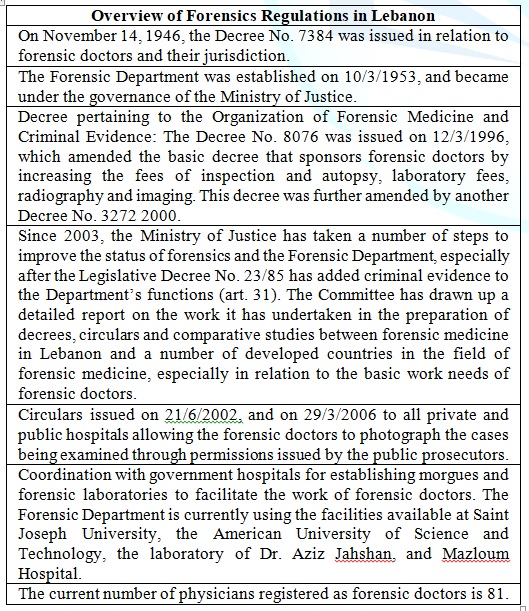
Table
2: Overview of Forensics Regulations in Lebanon.
Discussion and
Conclusion
Nursing education in Lebanon has
been well established for over 100 years in the capital city Beirut, but to a
much lesser extent in the rural sides of the country [23,24]. However, neither
Forensic Nursing education nor Forensic Nursing practice do exist in Lebanon.
Given the fact that the country is in need of forensic health services, which happen
to be limited and expensive, and that the number of qualified forensic doctors
does not exceed 81 for a population of 6,229,794 (based on the 2017
statistics), the establishment
of Forensic Nursing in Lebanon seems to be a necessity [12,25,26].
Forensic Nursing is defined as
the practice of nursing universally, whereby the legal systems and health
intersect. Death investigation, intimate partner violence, legal/criminal
justice, and administrative, correctional and psychiatric-mental health all represent
various specialties in Forensic Nursing [27,28]. The practice of Forensic
Nursing has soundly developed through the integration of modern forensic knowledge and technology
into nursing care. The aim is to enhance the healthcare services offered to patients
who experienced injury and brutality, and to act as early identifiers and
preventers of such injury and brutality. The malicious impacts, the propagation
of brutality over the life expectancy, and the requirement for injury-oriented
methodologies to assessment and care constitute the fundamental hypotheses to
Forensic Nursing practice.
A Registered Nurse (RN) could
specialize in Forensic Nursing through formal, well-structured, and
clinically-oriented university degree programs in the field. Their practice
venues include hospitals, psychiatric institutions, anti-violence programs,
coroners’ and medical examiners’ offices, communities (after natural disasters),
and correctional facilities [29-33]. He/she then becomes a Forensic Nurse
Examiner (FNE) whose roles include, but not limited to, the following [29-33]:
1 Providing
comprehensive nursing care to forensic patients in healthcare and community
settings.
2 Early
identification of victims, and prevention of assaults.
3 Clinical
forensic assessment.
4 Clinical
forensic investigation.
5 Clinical
forensic examination.
6 Clinical
forensic analysis.
These entail victims, suspects,
or perpetrators of unintentional or intentional psychological and/or physical trauma or
violence. Abuse of children and elderlies, intimate partner violence,
sexual harassment and assault, death, and/or natural disasters are among the
domains incorporated in the field [29-33]. Accordingly, Forensic Nurses must be
detail-oriented, skilled in collecting and preserving evidence that is
admissible in court, organized, and committed to vigilant and precise
documentation. Because nurses are skilled in effective documentation,
assessment, and communication, Forensic Nurses are then capable of the
following [29-33]:
1 Providing
sympathetic and empathetic care to victims of violent crime, abuse, or neglect,
while assembling evidence to maintain law enforcement.
2 Helping
their communities by working abreast with coroners and pathologists to detect
accurate causes of death and ensure exact recording of vital statistics and
epidemiology inclinations.
3 Consulting
with legal authorities and providing expert testimony that can be used in
court.
4 Addressing
violent crimes, such as homicide and attempted homicide, non-negligent
manslaughter, robbery, aggravated assault, adult sexual assault or rape, child
neglect, molestation or rape, and elder neglect or abuse.
5 Treating
physical injuries.
6 Gathering
and preserving evidence that is admissible in court (e.g., crime tools like
bullets, knives, etc., victim’s clothing and hair, as well as other physical evidence).
In conclusion, stress-related
disorders could range from simple anxiety to anger, rage, violence, assault,
homicide, and suicide. In a country like Lebanon where most of the Lebanese
people suffer from stress-related disorders, where psychological and psychiatric counseling
are financially out of reach, and where there is a severe shortage in
psychiatrists, mental
health nurses, and medical forensic practitioners, there is an urgent need
to introduce Forensic Nursing education, followed by establishing Forensic
Nursing practice. Graduates from such a degree will assume roles in clinical
forensics, teaching, legal nurse consulting, research, forensic psychiatric
nursing (evaluation of alleged perpetrators of violent crime), violence
prevention programs, and other roles that require collaboration with the
criminal justice system [29-33].
References
1.
American
Psychiatric Association. Diagnostic and statistical manual of mental disorders-DSM-5
(2013) 5th edn, American Psychiatric Publishing, Washington, DC, USA.
2.
American Psychiatric Association.
Diagnostic and statistical manual of mental disorders (1994) 4th
Edn, Washington, DC, USA.
3.
Kondo N. Socioeconomic
disparities and health: impacts and pathways (2012) J Epidemiol 22: 2-6.
4.
Margaret EB and Kristine MK.
Treating traumatic stress in children and adolescents: How to foster resilience
through attachment, self-regulation, and competency (2018) 2nd edn.
The Guilford Press, New York, USA.
5.
Judith LH and Bessel AK. Treating
complex traumatic stress disorders (adults: scientific foundations and
therapeutic models (ed) Christine AC and Julian DF (2013) The Guilford Press,
New York, USA.
6.
Breslau N, Kessler RC, Chilcoat
HD, Schultz LR, Davis GC et al. Trauma and posttraumatic stress disorder in the
community: The 1996 Detroit area survey of trauma (1998) Arch Gen Psychiatry
55: 626-632.
7. Cohen
JA, Mannarino AP and Iyengar S. Community treatment of posttraumatic stress
disorder for children exposed to intimate partner violence: A randomized
controlled trial (2011) Arch Pediatr Adolesc Med 165: 16-21.
https://doi.org/10.1001/archpediatrics.2010.247
8.
Cook A,
Spinazzola J, Ford J, Lanktree C, Blaustein M et al. Complex trauma in children
and adolescents (2005) Psychiatric Annals 35: 390-398.
https://doi.org/10.3928/00485713-20050501-05
9. Danielson CK,
McCart MR, Arellano MA, Macdonald A, Doherty LS et al. Risk reduction for
substance use and trauma-related psychopathology in adolescent sexual assault
victims: Findings from an open trial (2010) Child Maltreat 15: 261-268.
https://doi.org/10.1177/1077559510367939
10. Danielson CK,
McCart MR, Walsh K, Arellano MA, White D et al. Reducing substance use risk and
mental health problems among sexually assaulted adolescents: A pilot randomized
controlled trial (2012) J Fam Psychol 26: 628-635.
https://doi.org/10.1037/a0028862
11. Jordans
MJD, Tol WA, Komproe IH and De Jong JVTM. Systematic review of evidence and
treatment approaches: Psychosocial and mental health care for children in war
(2009) Child Adolescent Mental Health 14: 2-14.
https://doi.org/10.1111/j.1475-3588.2008.00515.x
12. World
Health Organization. Assessment Instrument for Mental Health Systems (WHO-AIMS
(2010) 1-25.
13. Nupur
K. Poverty, Inequality and Social Protection in Lebanon (2016) Oxfam and Issam
Fares Institute of American University Beirut, Lebanon.
14. National
Health Statistics Report in Lebanon (2012) Lebanon.
15. Nabil.
World Health Organization Case Study Lebanon (2004) Lebonon.
16. Najwa
Y and Lara B. Population and Housing in Lebanon (2012) Lebanon.
17. Elias
MC, Georges MC, and Bernard MC. Analysis of Accident Patterns in Lebanon (2010)
4th International Symposium on Highway Geometric Design, Valencia,
Spain.
18. http://erasmusplus-lebanon.org/content/24
19. Lebanese
Ministry of Justice (2018).
20. Antoine
EE. The Lebanese Legal System (1985) Georgetown University Publisher,
International Law Institute Washington DC, USA.
21. Houssam
Afif Chamseddine New Code of Criminal Procedure (2001) Legal Publications
Agency.
22. Fadi E, Rawan
H, Lina Y, Helen SN, Nadine A et al. The making of nursing practice Law in
Lebanon: A policy analysis case study (2014) Health Res Policy Syst 12: 52.
https://doi.org/10.1186/1478-4505-12-52
23. Huda AH, Samar
N and Nuhad D. Nursing in Lebanon (2005) Appl Nurs Res 18: 63-64.
https://doi.org/10.1016/j.apnr.2005.02.003
24. Saleh
F. Establishing a rural school of nursing in Lebanon: A practical model (2018)
Nursing and Health Care 3: 72-75.
25. https://www.justice.gov.lb/index.php/service-details/4/1
26. World
population prospects: The 2017 revision (2017) Department of economic and
social affairs, Population division volume II: Demographic profiles, UN, New
York, USA.
27. International
Association of Forensic Nurses (IAFN) (2009) Forensic nurse death investigator
education guidelines, Elkridge, MD, USA.
28. International
Association of Forensic Nurses (IAFN). Position statement: Violence is a public
health and health care issue (2009) Elkridge, MD, USA.
29. Lynch
VA. Forensic nursing science and the global agenda (2007) J Forensic Nurs 3:
101–111.
30. Lynch
VA. Evolution of forensic nursing science 2nd edn (ed) Duval JB (2011)
Elsevier, Netherlands.
31. Lynch
VA. Global expansion and future perspectives (2011) 2nd edn (ed)
Duval JB (2011) Elsevier, Netherlands.
32. Lynch VA.
Enrichment of theory through critique restructuring, and application (2014) J
Forensic Nursing 10: 120-121. https://doi.org/10.1097/JFN.0000000000000042
33.
Lynch VA and Duval JB. Forensic
nursing science 2nd edn (ed) St. Louis, (2011) Elsevier,
Netherlands.
Corresponding author
Saleh F, College of Public Health, Phoenicia University, Lebanon,
E-mail: fred.saleh@pu.edu.lb
Citation
Saleh
F and Ismail N. Forensic nursing education and practice in Lebanon: Current status
and future perspectives (2018) Nursing and Health Care 3: 80-83