Introduction
The
absence of the centralized system of the pharmaceutical product’s authorization
in Europe or USA has led to several tragedies: sulfanilamide elixir, thalidomide
tragedy and etc. [1]. This example shows that regulators should take into consideration
not only the properties of the known API but also the safety of the excipient as
well. Accordingly, Pharmaceutical Development should be carried out before manufacturing
any dosage form, even those with well-established API, in order to ensure compatibility
of all components of the medicine
product.
The
contemporary system of drug
monitoring, introduced in 1970s, has increased the quality, safety, and efficacy
control of medicinal
products. Despite the strictness of the Marketing Authorizations (MA) Law and
Good Manufacturing Practices (GMP), until the mid-1980s, it was possible to get
MA for several drugs without the FDA’s standard evaluation procedure (for example,
approval of the first antiretroviral drug-Azidothymidine) [2].
Nowadays,
all MA are conducted in accordance with the regulations and guidelines established
by Regulatory Authorities (RA), which on the other hand should be in accordance
with updated guidelines of the International Conference on Harmonization of Technical
Requirements for Registration of Pharmaceuticals
for Human Use. The tragic results related to the Elixir sulfanilamide and other
unregulated drugs made the specialization of healthcare regulatory affairs fast-growing
and in high demand in order to ensure that certification of
drugs meet regulatory standards for human use.
Regulatory
Affairs
Although
the specialization of the healthcare products by Regulatory Affairs Associate (RAA)
has only been around for about 40 years, it already had a tremendous impact on regulation
of the pharmaceutical market. The RAA specialty is becoming more and more popular.
According to the 2016 RAPS report, 88% of current regulatory professionals had been
working in a different industry before transitioning into regulatory
affairs; moreover, about 70% of working RAAs are satisfied with their current
jobs [3].
It
is possible to become a RAA if a person has a relevant degree in fields such as
chemistry, medicinal chemistry, biochemistry, biotechnology, pharmacy,
pharmacology, physics, biomedical science, or other similar fields. Continuing education
and professional development are critical for the regulatory professional. Regulatory
professionals must keep up to date with regulatory policies and procedures from
one or more countries, as well as maintain an understanding of the scientific and
technical background of healthcare products. Global aspects of regulatory affairs
are taken up by organizations such as the Drug Information Association (DIA) [4].
Nowadays
it is possible to gain a master’s degree in regulatory affairs at many well-respected
U.S. universities [5]. There are also several professional organizations which are
helpful for career development in regulatory affairs:
- Regulatory Affairs
Professionals Society (RAPS)
- NIH National Center
for Complementary and Integrative Health, Office of Clinical and Regulatory Affairs
(NCCIH/OCRA)
- The Organization for
Professionals in Regulatory Affairs (TOPRA)
- Orange County Regulatory
Affairs Discussion Group (OCRA)
- US Food and Drug Administration,
Office of Training Education and Development (OTED)
Large
pharmaceutical companies recognized the necessity of a professional staff that would
be involved in the process of pharmaceutical product authorization and be familiar
with International standards and guidelines for healthcare products, as specific
laws and queries varies in different countries. This staff would be able to provide
valuable analysis of the lifecycle of a product using regulatory knowledge and critical
thinking skills. Thus, the regulatory affairs department has become an essential
unit of pharmaceutical companies.
The
functions of RA department are very clear and detailed described in Chapter 20-Regulatory
affairs of the book Drug
Discovery and Development (Second Edition): “The RA department reviews all documentation
from a regulatory perspective, ensuring that it is clear, consistent and complete,
and that its conclusions are explicit. The department also drafts the core prescribing
information that is the basis for global approval and will later provide the platform
for marketing. The documentation includes clinical trials applications, as well
as regulatory submissions for new products and for changes to approved products.
The latter is a major task and accounts for about half of the work of the RA department”
[6].
Along
with this department, there are Regulatory Affairs managers (RAMs) working mostly
independently from the manufacturer, located in the country or region where a manufacturer
aims to authorize a future
healthcare product. Their ability to analyze the lifecycle of a product and
determining the types of Variations (if any) using local regulatory knowledge is
very useful for pharmaceutical companies. In keeping with best practice standards,
independent RAMs should keep track of the often-changing legislation in all the
regions in which a company wishes to distribute its products.
The
RAM acts as a bridge between pharmaceutical companies and regulatory authorities,
ensuring that products are manufactured and distributed in compliance with appropriate
legislation. It would be a mistake to regard the regional RAM as a mere courier.
It is quite the contrary; one of the responsibilities of a RAM is to prepare the
submission dossier, and with developing strategies to ensure regulation compliance,
which often means long negotiations with the Manufacturer/MAH as well as National
Regulatory Authority. The RAM should keep each interested department to be informed
in each registration.
A
RAM can influence establishment of the standards for a company's operating procedures
and can also help develop company policies concerning how the business operates.
The RAM often needs to act as a diplomat, since the requirements from local Regulatory
Authority do not always meet the manufacturer’s interests. The scope of RAM’s functions
is to plan, direct, or coordinate production activities of a pharmaceutical company
to ensure compliance with regulations and standard operating procedures.
Like
with respect to other types of regulations, Georgia is striving to comply with the
European regulation standards, when it comes to pharmaceutical market. During the
USSR, pharmaceutical regulations were centralized and applied through Russia, while
other Soviet Republics only utilized local pharmacological committees and laboratories
for making pharmacological product quality decisions. After the collapse of the
Soviet Union, Georgia, as a new country, has realized the necessity of such regulations.
The creation of the Drug Regulatory Agency became the core mission in the spontaneous
and chaotic market of that time.
The
Pharmaceutical Law of Georgia which regulates the scope of regulatory affairs in
Georgia is as follows: there are two regimes of registration in Georgia-Recognition
regime and National one. Under the Recognition regime it is possible to register
(during 7 working days) pharmaceutical products, which are already authorized in
USA, Canada, EU member states and other countries from official “List of eligible
countries” [7]. The
deadline of National regime process is within 3 months after the required documents
submission. A regional RAM is responsible for tracking the market for possible shortages
for a specific type of product within the country, as technology has made information
widely accessible and easily spread, which is very helpful to manage the situation.
The
pharmaceutical legislation in many countries regulates mostly only pharmaceutical
products, but also extends to the regulation of medical devices, dentistry materials,
and sometimes food/dietary supplements. Food/dietary supplements regulation remains
sloppy around the world; for instance, in the United States, dietary supplements
do not need approval from the FDA before marketing. Only companies that manufacture
or distribute dietary supplements containing “new dietary ingredients” are required
to submit premarket safety notifications. Consequently, there are not any approved
standards for those products and no assurance of their safety [8].
The
European Commission model covers a definition of health supplements, provisions
to establish risk assessments, labeling requirements, and a negative list of ingredients,
provisions for nutrition and health claims, and standards for GMP for food supplements
[9]. In addition to registrations, a RAM sometimes is required to conduct Pharmacovigilance
- a new direction in the field.
Pharmacovigilance
WHO
defines pharmacovigilance as: the science and activities relating to the detection,
assessment, understanding and prevention of adverse effects or any other drug-related
problem [10].
The
legal scope for pharmacovigilance for healthcare products in the EU/European Economic
Area (EEA) is set out in several Directives, which describe the obligations of MAH
and the Regulatory Authorities. This requires them to set up a system for pharmacovigilance
in order to:
- collect, collate,
and evaluate information about reported and suspected adverse reactions;
- Share relevant information
to allow all parties involved to meet their obligations and discharge their responsibilities.
Information
about drug safety is obtained from several sources, including:
- Spontaneous adverse
drug reaction (ADR) reporting reports.
- Post-approval clinical
studies and investigation of health and diseases in wider populations.
- Information from pharmaceutical
companies and information published in medical literature.
- Information from regulatory
authorities worldwide and from morbidity and mortality databases.
MAH
are required to have a system of monitoring and reporting to the regulatory authorities
on the safety of their products. This requires the collection and reporting of spontaneous
safety events, and the collection and evaluation of safety data from various sources
over the lifecycle of pharmaceutical products. Minimum criteria for Adverse Event
reporting are Patient, Reporter, Event and Product.
For
new products, this is defined in a
pharmacovigilance plan that is part of the risk planning information that accompanies
an application for a marketing authorization [11]. However, regardless of active
regulations, side effects of marketed pharmaceutical
products still persist, and information about pharmaceutical products, containing
API Ranitidin is an obvious example [12].
In
today’s world such incidents receive a fast response on international and local
levels. For example (Figure 1), here
is published information about
carcinogenicity of the Zantac itself and its generics: The incident was published
next day on the Georgian MOH’s official site (Figure 2) and gives information about postponement of registration of
all registered products with Ranitidin in composition [13].
Zantac
(Ranitidine) belongs to a group of drugs called histamine-2 blockers. Ranitidine
works by reducing the amount of acid produced by stomach. The reason for a recall
was based on the fact that traces of N-nitrosodimethylamine (NDMA) were found in
ranitidine generics. “Initial testing suggested generic Zantac was “contaminated”
with NDMA; however, it now appears that ranitidine is a fundamentally unstable molecule
and NDMA forms during the degradation or breakdown of the molecule, meaning that
no form is safe”. Such
a fast reaction is a positive change and gives reassurance on timely actions in
case of an unsafe or potentially dangerous product.
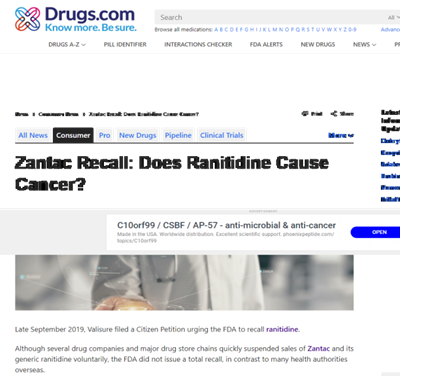
Figure 1: Published information about carcinogenicity of the Zantac.

Figure 2: Information aboutpostponement of registration of all registered products with Ranitidin in composition.
Actions
taken for the identification and remediation of the possible Adverse Effect (AE)
(side reactions) on the regulatory level is to be attributed to the Pharmacovigilance.
Pharmacovigilance is used to:
- To improve public
health and safety in relation to used medicines.
- To contribute to the
assessment of benefit, harm, effectiveness and risk of medicines encouraging their
safe, rational and more effective use.
- To promote understanding,
education and training in pharmacovigilance and its effective communication to health
professionals and the public, in timely manner.
On
the one hand, global and local Regulatory obligations safeguard to ensure optimal
efficiency of the pharmacovigilance system, and, as a result, to increase harmonization
between all concerned parties. On the other hand, pharmaceutical companies have
regulatory obligations to report AE to the relevant Regulatory Authority. Due
to the fact that at the beginning of my career, I was engaged in preclinical as
well as clinical trials of testing new drugs for me personally it is clear that
clinical trials are being conducted to ensure safety of each product before applying
for a marketing authorization.
However,
on a local level, it is still hard to collect information about the side effects,
would it be from a patient or a healthcare professional. From personal practice,
I was notified by a doctor about a side effect of a drug. Although having checked,
on my behalf, all the points in PREP (Patient, Reporter, Event and Adverse Event),
doctor has refused to provide more detailed information upon request. Regardless
of the lack of feedback, the precedent of the side effect was made known to the
contact person of the MAH. Unfortunately, there is a lack of reciprocal communication
between: the person involved in PV, the health professional and the patient.
There
might be a growing need for the local level conferences that cover not only the
efficacy of the pharmaceutical products, but also hold discussions about AE to ensure
high quality of the public health.Alongside the PV, fight against the falsifications
of pharmaceutical products holds a high priority. For that reason, on the 09th February
2019, the EC has revised a directive about counterfeit pharmaceutical products for
this purpose; serialization is the key factor [14].
“These
new requirements will enhance patient safety by protecting the medicines supply
chain from infiltration by counterfeit medicines and introducing new rules to more
rigorously regulate the supply chain… (and) provides further security and protection
for Irish and European patients now and into the future.” The
directive necessitates the inclusion of two safety features on all prescription
medicine packs in the European Union market: a unique 2D barcode and an Anti-Tampering
Device (ATD). Pharmacies, drug stores and those authorized to supply medicines to
the public are now required to authenticate products at point-of-sale by visually
inspecting the ATD and performing a verification scan of the product using the barcode.
Conclusions
Local
Regulatory Affairs Manager is important for regulatory framework for healthcare
products authorization, as he/she is binding Governmental Regulatory Authorities
and manufacturer/MAH of pharmaceutical products, being functioning like a mediator
between them. The RAMs are reducing time for product reaching on the market, and
accordingly, have considerable economic importance for any pharmaceutical company.
Pharmacovigilance
is very important topic for ensuring pharmaceutical product’s safety, and bodies,
involved in pharmacovigilance should collect and report about any AE to manufacturer/MAH,
as well as to Governmental Regulatory Authorities. Providing Pharmacovigilance service
in Georgia is still difficult because of low self-awareness in this regard among
healthcare
professionals and country’s population. The new safety feature may help them to
be better aware of counterfeit medicinal products, too.
References
- Florence AL. Is Thalidomide
to Blame? (1960) Br Med J 2: 1954.
- HIV/AIDS Historical
Time Line 1981-1990
- Scope of practice
& compensation report for the regulatory profession (2016)
- Drug Information Association.
- Online Master's in
Regulatory Science Programs.
- Hägglöf II and Holmgren
A. Drug Discovery and Development (2013) Science direct, United Kingdom pp-285-301.
https://doi.org/10.1016/b978-0-7020-4299-7.00020-2
- Law of Georgia on
“Drugs and Pharmaceutical Activity” (1997) Bulletin of Georgian Parliament:17-18.
- Dietary Supplements
Guidance Documents & Regulatory Information
- Food supplements
- Essential medicines
and health products
- Guidance on the format
of the risk management plan (RMP) in the EU – in integrated format
- Zantac Recall: Does
Ranitidine Cause Cancer?
- Suspension of registration
of pharmaceutical products containing ranitidine
- Commission Delegated
Regulation (EU).
*Corresponding author: Elene Chikobava, Department
of Regulatory Affairs, “Quadrium Pharmhouse” Ltd, Tbilisi, Georgia, Tel:
+955 595 555 224, E-mail: e.chikobava@gmail.com
Citation: Chikobava
E and Beridze I. The challenges to be a regulatory affair associate: day-to-day
questions on how to reach consensus between manufacturers of pharmaceutical products
and government regulatory authorities (2020) Pharmacovigil and Pharmacoepi 3: 37-40.