Microstomia
is a condition with abnormally small oral aperture which is associated with
compromised aesthetics and function of stomatognathic system. In young
children, the leading cause of microstomia is oral electrical or chemical
burns. Management of microstomia requires multidisciplinary approach including
surgery, physiotherapy and appliance therapy. Appliance therapy in form of microstomia
prevention appliance plays a pivotal role in prevention of contraction of
tissue during healing. Numerous appliances have been described in literature to
prevent microstomia. However, decision to use a particular appliance require
meticulous planning considering the efficacy and effectiveness of the
appliances and various patient factors like age, dentition status and
compliance. This paper presents an unusual clinical condition where a unique
customized microstomia prevention appliance therapy was instituted to prevent
microstomia in 2 year old female patient following lip surgery. This appliance was
constructed easily and inexpensively, could be adjusted so that it was almost
painlessly inserted, and was progressively adapted. It was convenient for use
in young child with minimal compliance offering improved mouth opening and
consequently functional outcomes.
Introduction
Microstomia
is an unusual condition characterized with abnormally small or insufficient
oral aperture which can be attributed to congenital or acquired etiological
factors. Literature states that during 1990s, electric and chemical oral burns
were common cause of microstomia in children [1]. Such injuries cause adhesion
of lips, constriction
of lip commissure and generalized contracture of
wound while healing thereby leading to scarring, deformation and lastly
microstomia [2]. The inadequate oral opening hampers facial expression, oral
feeding, speech and oral hygiene maintenance there by compromise aesthetics,
psychological health and quality of life of an individual. Furthermore,
difficulty in oral hygiene results in increased incidence of oral diseases such
as caries, periodontal
diseases and other infections, with limited
scope for treatment [3].
The detrimental effects of
microstomia can be managed by complex surgery followed by prosthodontics
intervention as Microstomia prevention appliance. Microstomia prevention
appliance is a commissural retractor by which its horizontal forces restrict
contraction of tissue during healing and prevent microstomia [1]. Literature
describes various types of microstomia
prevention appliances indicated in variable clinical
scenario, selection of which depends on the age of patient and dentition
status. However, certain unusual clinical condition may demand modification or
innovation for successful treatment. This paper presents one such distinctive
approach to prevent microstomia in 2 year old female patient following lip
surgery.
Case
Report
A 2 year old female reported to
Department of Prosthodontics, Government Dental College and Research Institute,
Bangalore with complaint of limited mouth opening since 1 year. Patient was
accompanied by her parents who reported that 1 year back patient suffered from
fever which was also associated with blisters at corner of lips. Subsequently,
they applied an over the counter medicated ointment over the blister
on lip commissures which lead to burn followed
by progressive scaring, contracture and limited the mouth opening. Patient then
underwent surgery to relieve microstomia which was successful but never
approached any prosthodontist for any appliance for prevention of microstomia
resulting in contracture of tissue and relapse of microstomia.
On examination, the mouth opening
of patient was about 1cm with shallow lower anterior labial vestibule (Figure 1). There was generalized loss
teeth structure due to carious lesion owing to minimal mouth opening and
inadequate oral
hygiene practice. Considering the severity of microstomia,
patient was planned for surgical release of microstomia followed by insertion of
microstomia prevention appliance.
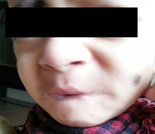
Figure
1: Patient in outpatient department.
In this case, fixed or removable
tooth borne appliance was first considered, however insufficient sound teeth
contraindicated its fabrication. Extraoral
headgear appliance was also excluded due to
aesthetic consideration and lack of patient compliance. Hence, customized
microstomia prevention was fabricated understanding the clinical state.
Procedure
Patient was posted for surgery
immediately after which an impression was made using putty based addition
silicon impression material in metallic check retractor of lip commissure (Figure 2). Following this the
impression is replicated using alginate material to prepare molds for
fabrication of lip conformer. Denture relining material was then injected into
the both molds and allowed to set. Subsequently both the lip conformers were
retrieved and finished (Figure 3).

Figure
2: Surgery and impression.
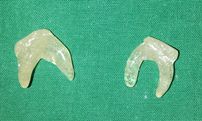
Figure
3: Lip conformers.
A pre-fabricated pacifier for kid was used to make
this microstomia prevention appliance. The horizontal length of oral aperture
was estimated using vernier caliper. The lip conformers were then adjusted and
attached to pacifier to achieve the measured horizontal length of oral
aperture. The lip conformer is attached to pacifier using chemically
polymerized poly(methyl
methacrylate) resin (Figure 4). The customized microstomia
prevention appliance was then tried in patient mouth and finished and inserted (Figure 5).
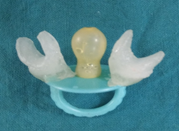
Figure
4: Customized microstomia prevention appliance.
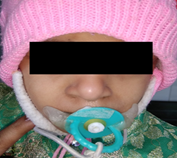
Figure
5: Appliance insertion.
Patient was instructed to wear
the appliance throughout the day and night except during meals. Patient was
regularly followed up at weekly intervals. After initial healing period that is
around 15 days, the soft
reliner was replaced with clear chemically
polymerized poly(methyl methacrylate) resin. Four months following surgery, the
horizontal length of oral aperture was well maintained at around 5 cm (Figure 6). Patient was followed up with
three months post-surgery and one year after surgery (Figure 7).
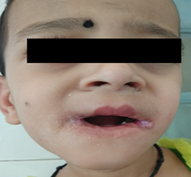
Figure
6: Four months follow up.

Figure
7: One year follow up.
Discussion
Post-surgical management of
microstomia is a crucial component of treatment as comprehended in present
case. Any negligence in institution of microstomia prevention appliance can
lead to relapse of microstomia and failure of surgical procedure. The basic
foundation of these appliances as stated by Holt et al. relies on ability of oral
sphincter to respond to external distracting
forces [4]. A plethora of diverse microstomia prevention appliances are
documented in the literature. Decision to use a particular appliance in
management of these patients should be planned mutually by the physician and prosthodontics
that are familiar with the efficacy and effectiveness of the appliances and
various patient factors like age, dentition status and compliance.
Microstomia prevention appliances
can be categorized as static or dynamic appliance. Static devices act as
commissural splint during healing period and dynamic device are the one which
provide retracting forces [5,6]. These appliances can also be grouped as
whether they are intraoral or extraoral and removable or fixed [7]. Present
appliance can be classified as static extra oral removable microstomia
prevention appliance.
Josell et al, in 1984 underlined
the various requirement of ideal appliance which were, 1) Simple, non-traumatic,
and inexpensive to fabricate; (2) Easily inserted and removed with minimal
discomfort to patient; (3) Well tolerated by patient, comfortable to wear, and
compatible with appliance-bearing tissue; (4) Retentive and well-adapted at the
site of injury [8]. The present customized
microstomia appliances meet all the above criteria to
the completest.
The appliance therapy used in
present case was acceptable to the child in spite of her young age and lack of
cooperative behavior. In addition, it was easy to fabricate at minimal time
lost following surgery. Also, it allows hassle-free periodic correction and
adaption for improved results in prevention of microstomia.
References
1.
Silvestre RJ, Herrera MM and
Silvestre FJ. Dental management of patients with microstomia. A review of the
literature and update (2015) J Oral Res 4: 340-350.
https://doi.org/10.17126/joralres.2015.065
2.
Le Compte EJ and Barry M. Oral
electrical burns in children-early treatment and appliance fabrication (1982)
Pediatr Dent 4: 333.
3.
Antonarakis GS, Fastlicht S,
Masnyi T and Tompson B. Postburn Microstomia Prevention Using an Appliance
Providing Simultaneous Horizontal and Vertical Adjustable Forces (2017) J Burn
Care Res 38: e977-e982.
https://doi.org/10.1097/BCR.0000000000000523
4.
Holt GR, Parel S, Richardson DS
and Kittle PE. The prosthetic management of oral commissure burns (1982) Laryngoscope
92: 407-411. https://doi.org/10.1288/00005537-198204000-00009
5.
Nitzan DW, Azaz B and Constantini
S. Severe limitation in mouth opening following transtemporal neurosurgical
procedures: diagnosis, treatment, and prevention (1992) J Neurosurg 76: 623-625.
https://doi.org/10.3171/jns.1992.76.4.0623
6.
Sadrimanesh R, Hassani A, Vahdati
SA, Chaghari H, Sadr-Eshkevari P, et al. Freeman-Sheldon syndrome: Combined
surgical and non-surgical approach (2013) J Cranio-Maxillofac Surg 41: 397-402.
https://doi.org/10.1016/j.jcms.2012.11.004
7.
Linebaugh ML and Koka S. Oral
Electrical Burns: Etiology, Histopathology, and Prosthontic Treatment (1993) J
Prosthodont 2: 136-141. https://doi.org/10.1111/j.1532-849X.1993.tb00396.x
8.
Josell SD, Owen D, Kreutzer LW
and Goldberg NH. Extraoral management for electrical burns of the mouth (1984)
ASDC J Dent Child 51: 47-52.
*Corresponding author
Mohammed Ajmal, Senior Lecturer, Department of Prosthodontics, KGF College of Dental
Sciences, BEML Nagar, Kolar Gold Fields, Kolar, Karnataka 563115, India,
E-mail: drmdajmal@gmail.com
Citation
Ajmal M, Kaur M, Saleem M and Premnath K. Customized
microstomia prevention appliance therapy: a case report (2019) Dental Res Manag
3: 42-44