Explore journal overview, editorial leadership, indexing, articles in press, latest published work, and highlights from previous issues.
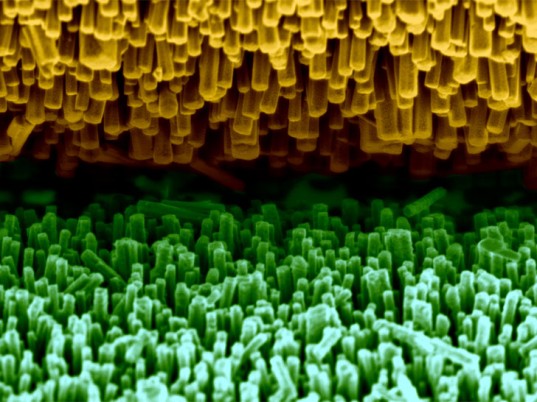
Nanostructure is an object of intermediate size between molecular and microscopic structures. These structures are usually probed either optically in Spectroscopy, Photo-luminescence or in transport experiments. As the properties of solids depend on size, atomic structure and chemical composition, nanostructure materials exhibit new properties due to one or several of the following effects Size effects, Change of the dimensionality of the system, Changes of the atomic structure, Alloying of components, Microstructures, Non-equilibrium Nanostructured Materials, Classification of Nanostructured Materials, Reduced density and coordination in the boundaries, Chemical bonding effects, Temperature effects, Grain growth, Formation of non-equilibrium alloys, Polymeric Nanostructured Materials, Self-organized nanostructured arrays.
Nanomaterial chemistry and technology is a global open access journal maintaining high standards of scientific excellence and its editorial board ensures a rapid peer review process and Nanomaterial chemistry and technology welcomes all research works on Nanostructure. And also as well as case reports on Nano-medicine, articles on Nano-scale materials, research on Nano robotics, research on nanoparticles, and also deals with the Nano science and technology journals.
Researchers, authors, reviewers, and readers can use this page to find journal resources connected with Nanostructure, including published articles, related academic topics, current issue content, archive material, and manuscript submission information.
The rationale behind targeted drug delivery is to produce a system that can deliver drugs at rates finely tuned to the biological requirements of the body [6] with high specificity and...
To investigate morphological, optical and antibacterial properties of SnO2 nanoparticles which are synthesized by using an easy and affordable Sol-Gel method. By using various techniques...
Palladium nanoparticles (ca. 4.8 nm) were synthesized in presence of 1-n-butyl-3-methylimidazolium tetraflouroborate (BMI.BF4) and 1-n-butyl-3-methylimidazolium hexafluorophosphate...